
Uzbekistan’s Cultural Renaissance: From the Silk Road to World Heritage Modernism
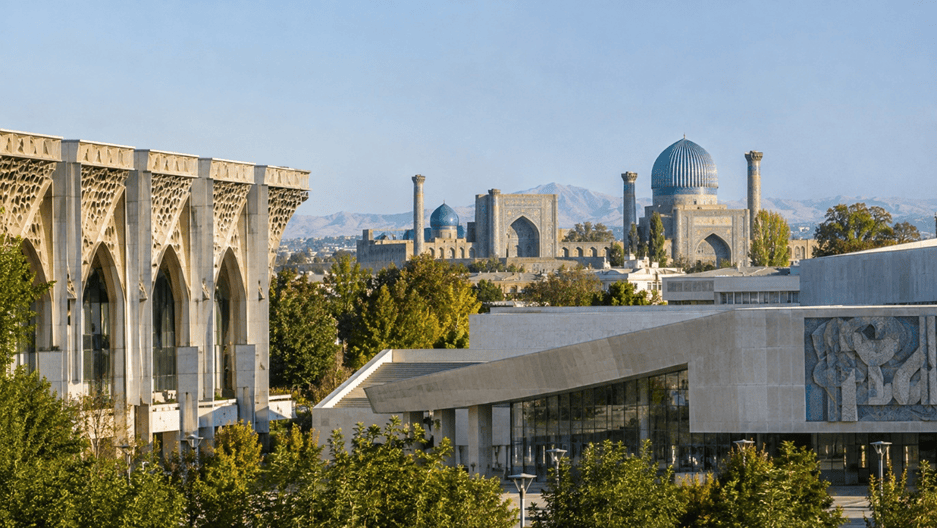
A year of UNESCO recognition, new institutions and Uzbek culture on the world’s leading stages
For centuries the world has known Uzbekistan through the turquoise domes of Samarkand, Bukhara and Khiva. In 2026 it discovered another chapter of the country’s story. On 26 July, the UNESCO World Heritage Committee inscribed ten modernist landmarks of Tashkent on the World Heritage List – Uzbekistan’s first national nomination to succeed in 25 years, and the first time 20th-century modernist architecture in Central Asia or the CIS has received this recognition.
The inscription crowned a remarkable year. A new Centre for Islamic Civilization and a Centre for Contemporary Arts opened in Tashkent, Uzbek heritage travelled to Doha, Milan and Venice, and Registan Square in Samarkand once again became one of the world’s most spectacular concert stages.
1. Tashkent modernism joins the World Heritage List
The decision was taken at the 48th session of the World Heritage Committee in Busan, Republic of Korea. The ten inscribed properties were built between the 1960s and the early 1990s, when Tashkent was rebuilt after the devastating earthquake of 1966. They include the Palace of Peoples’ Friendship, the State Museum of History, the State Museum of Arts, the Tashkent State Circus and the Zhemchug residential building.
What makes them exceptional is their synthesis. Architects from Moscow and Tashkent combined the functionality of modernism with Central Asian courtyards, loggias and geometric ornament, and with solutions suited to a hot climate and seismic risk. The nomination grew out of Tashkent Modernism XX/XXI, a research and preservation project launched in 2021 by the Uzbekistan Art and Culture Development Foundation (ACDF). With this inscription, Uzbekistan now has six cultural properties on the World Heritage List.
2. New homes for heritage and contemporary art
On 17 March 2026, the Centre for Islamic Civilization opened to the public in Tashkent. It brings together a museum, research units, a library, archives, restoration laboratories and educational spaces. Guinness World Records recognises it as the largest museum of Islamic civilization in the world, and the Centre has already received six international awards and distinctions.
Six months later, on 6 September, the Centre for Contemporary Arts Tashkent (CCA Tashkent) opened as the country’s first permanent institution for contemporary art. It occupies a 1912 tram depot and diesel station designed by Wilhelm Heinzelmann, transformed by the Paris-based Studio KO. The architects preserved the original yellow-brick façade and commissioned bespoke tiles from the Rakhimov family ceramics studio, a Tashkent dynasty of master potters. The inaugural exhibition, Hikmah, curated by Chief Curator Sara Raza, runs until 31 January 2027, with free admission.
More is on the way: a new National Museum of Uzbekistan designed by Tadao Ando and a Jadids’ Legacy Museum in Bukhara.
3. Uzbek culture on the world stage
The first Bukhara Biennial in 2025 drew more than 1.8 million visitors to the city’s mosques and madrasas. Preparations for the 2027 edition are under way, and in October 2026 the ACDF signed a long-term cooperation agreement with the Centre Pompidou in Paris.
Abroad, Uzbekistan has been present at some of the most prestigious venues in the world:
Venice. At the 61st Venice Biennale, the national pavilion The Aural Sea turned the story of the Aral Sea into a reflection on memory and renewal.
Milan. At Milan Design Week in April, the pavilion When Apricots Blossom presented collaborations between 12 international designers and 12 artisans from Uzbekistan
and Karakalpakstan. Since 5 November, eight Uzbek artefacts have been on display in Global Antiquity at Fondazione Prada, an exhibition designed by Rem Koolhaas and AMO/OMA that runs until 1 March 2027.
Doha. In September, the Museum of Islamic Art opened Uzbekistan: Heritage in Motion, part of a five-year partnership between Qatar Museums and the ACDF.
4. Music under the domes of Registan
On 6 September 2026, Lang Lang performed at Registan Square for the first time, joined by the National Symphony Orchestra of Uzbekistan under Alibek Kabdurakhmanov in a programme of Beethoven’s “Emperor” Concerto and Gershwin’s Rhapsody in Blue. The concert followed Andrea Bocelli’s performance on the same square in 2025 and confirmed Samarkand’s place as a destination for cultural tourism.
5. Culture as dialogue
Culture also carries Uzbekistan’s message of tolerance abroad. In March 2026 an Uzbek delegation in Stockholm met the Deputy Speaker of the Riksdag, Sweden’s Special Representative for Interreligious Dialogue and leaders of the city’s mosque and churches to share the country’s experience of interfaith harmony. In Karakalpakstan, the new Aral School in Nukus, working with the celebrated Savitsky Museum, brings artists and researchers together to imagine the future of the Aral Sea region.
Conclusion
In a single year, Uzbekistan has seen its 20th-century architecture enter the World Heritage List, opened two major cultural institutions and presented its heritage in Venice, Milan and Doha. The country is no longer known only for its ancient past: it is building a living cultural scene that links the Silk Road to the present day, and it is inviting the world, including Nordic audiences, to take part.
Kategorier:Okategoriserade


