
From Samarkand Stockholm, a decade of foreign policy that has turned a once-closed country into a sought-after partner
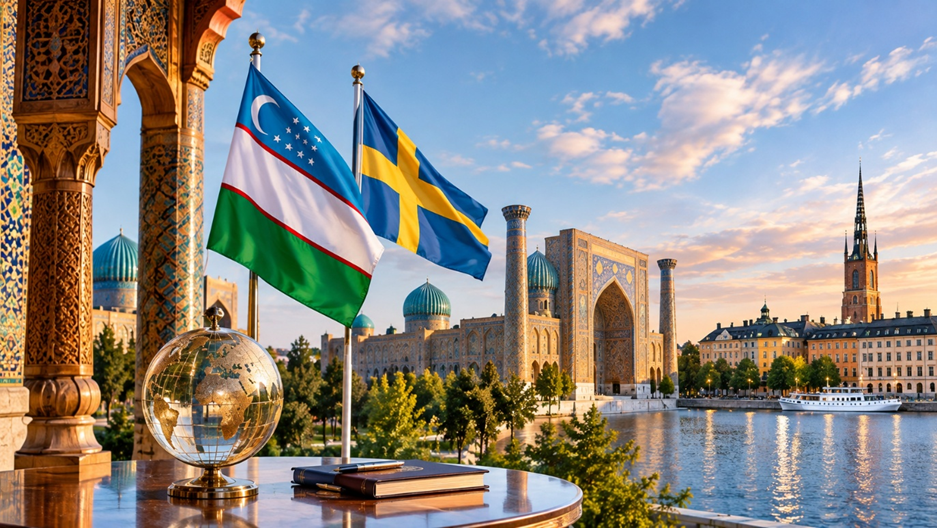
On 19 October 2026, the foreign ministers of the five Central Asian states gathered in Samarkand with US Secretary of State Marco Rubio for a C5+1 ministerial meeting. The setting was symbolic: the format was born in the same city in 2015. This time, according to Rubio, nearly 300 American companies were represented in Samarkand. Uzbekistan and the United States held their first Strategic Partnership Dialogue, and Tashkent signed the Artemis Accords on space cooperation.
The meeting captured how far Uzbekistan has come. A decade ago it was one of the most closed countries in the region. Today Samarkand hosts summits with Washington and Brussels alike, and the country describes its diplomacy in three words: open, pragmatic and proactive.
1. A transformed neighbourhood
The defining achievement of President Shavkat Mirziyoyev’s foreign policy has been the transformation of Uzbekistan’s immediate neighbourhood. Borders have reopened, long-standing disputes have been settled through dialogue, and regional trade has flourished. By June 2026 Uzbekistan was home to 2,384 enterprises with capital from other Central Asian countries.
Regional cooperation has also gained new institutions. At the Consultative Meeting of Central Asian heads of state in Tashkent in November 2025, Azerbaijan was admitted as a full participant, creating a new “Central Asia and Azerbaijan” format. In July 2026, at the leaders’ meeting in Cholpon-Ata, Mirziyoyev proposed a unified development space linking Central Asia, the South Caucasus and Afghanistan. The Termez Dialogue, launched in 2025 and convened again in 2026, is turning that vision into practical coordination among governments, businesses and regional institutions.
Swedish experts have noticed. Johan Engvall of Stockholm’s Institute for Security and Development Policy (ISDP) has described Uzbekistan as playing a leading role in advancing voluntary cooperation across Central Asia.
2. Partners in every direction
Uzbekistan’s multi-vector diplomacy means strengthening ties with all major centres of power without choosing one against another.
- Europe. In April 2025 Samarkand hosted the first EU–Central Asia summit, which elevated relations to a strategic partnership. In October 2025 Uzbekistan and the EU signed an Enhanced Partnership and Cooperation Agreement in Brussels, replacing the 1996 agreement. Its 356 articles cover trade, critical raw materials, energy, climate, education and the Aral Sea. On 20 May 2026 the European Parliament gave its consent by 423 votes to 16.
- The United States. Beyond the C5+1, the two countries signed a memorandum on critical minerals and rare earths in February 2026, and 193 American companies took part in the Tashkent International Investment Forum in June.
- Asia and the Gulf. China is the largest foreign investor, with more than USD 8 billion invested since the start of 2026, while Saudi Arabia and the United Arab Emirates have become major investors.
3. A stronger voice at the United Nations
At the 81st session of the UN General Assembly in September 2026, Saida Mirziyoyeva, Head of the Presidential Administration, delivered Uzbekistan’s address. She placed human dignity, openness and dialogue at the centre, called for a United Nations that can act and not only decide, backed an expansion of the Security Council and reiterated Uzbekistan’s bid for a non-permanent seat.
Uzbekistan’s initiatives are increasingly reflected in UN decisions. The country was among the sponsors of the General Assembly resolution proclaiming the United Nations Decade for Afforestation and Reforestation in line with Sustainable Forest Management (2027–2036). In April 2026 it secured its first-ever seat on the UN Commission on Crime Prevention and Criminal Justice.
4. Diplomacy that delivers results
Uzbekistan’s diplomatic network keeps expanding: in April 2026 Guinea-Bissau became the th country to establish diplomatic relations with Tashkent. In 2025 Uzbekistan signed 310 international agreements and established relations with nine new states, and in the first ten months of that year USD 34.4 billion of foreign investment was mobilised with the support of diplomatic missions. Building on these results, in January 2026 the President set the diplomatic service a new task: to make foreign policy more measurable, with embassies judged on concrete results in trade, investment and the protection of citizens abroad.
5. Sweden and Uzbekistan: a partnership with new substance
Sweden decided to establish diplomatic relations with Uzbekistan on 2 April 1992. In 2026 the relationship gained new substance.
On 10 June 2026 in Tashkent, the two governments signed the Agreement on Comprehensive Partnership in the Field of Migration and Mobility – the first intergovernmental migration agreement between the two countries – together with a joint declaration on a pilot programme implemented with the International Organization for Migration. The agreement entered into force on 1 November 2026. It establishes a framework for cooperation on legal labour migration, vocational training and academic exchanges, while facilitating contacts between Uzbek candidates and Swedish employers, with initial focus on healthcare, engineering, services and caregiving. It also provides for the protection of migrants’ rights, closer cooperation against irregular migration and human trafficking, and a 30-day visa-free regime for holders of diplomatic passports. Implementation has already begun: in November 2026 an Uzbek delegation led by the Director of the Migration Agency held talks in Stockholm with Sweden’s Ministry for Foreign Affairs and Minister for Migration Johan Forssell.
The agreement crowns an intensive year. In March an Uzbek delegation held talks in Stockholm on interreligious dialogue with the Deputy Speaker of the Riksdag and Sweden’s Special Representative for Interreligious Dialogue. In May the embassies of Uzbekistan and Kazakhstan hosted a business seminar at the Riksdag with more than 30 Swedish companies, and Lund University, together with the foreign ministries of Sweden and Denmark, convened talks on Central Asia–Nordic cooperation.
Conclusion
In ten years Uzbekistan has moved from isolation to the centre of Eurasian diplomacy. It hosts the world’s major powers in Samarkand, shapes the regional agenda and speaks with growing confidence at the United Nations. For Sweden, the migration and mobility agreement shows that this openness is translating into concrete cooperation that benefits people in both countries – and that the partnership between the Nordics and Central Asia has only just begun.
Kategorier:Okategoriserade


