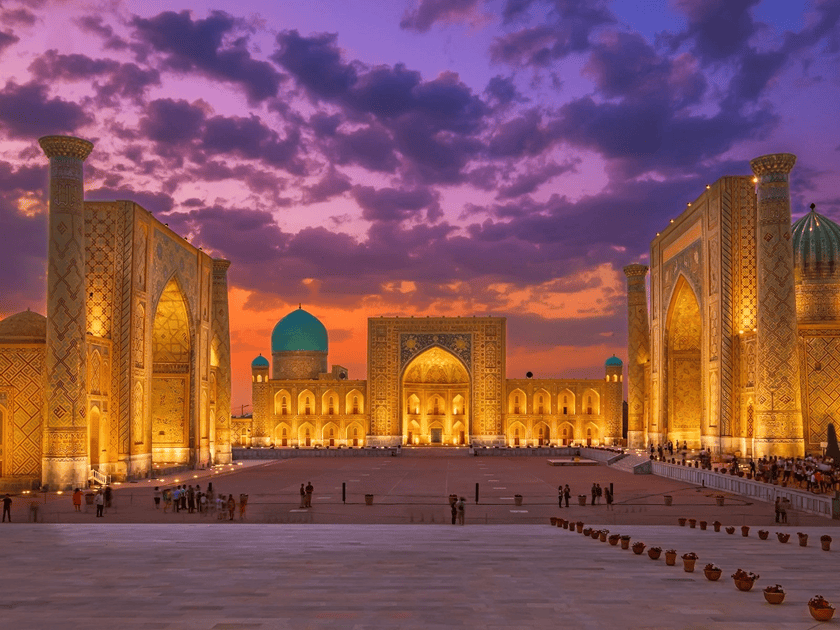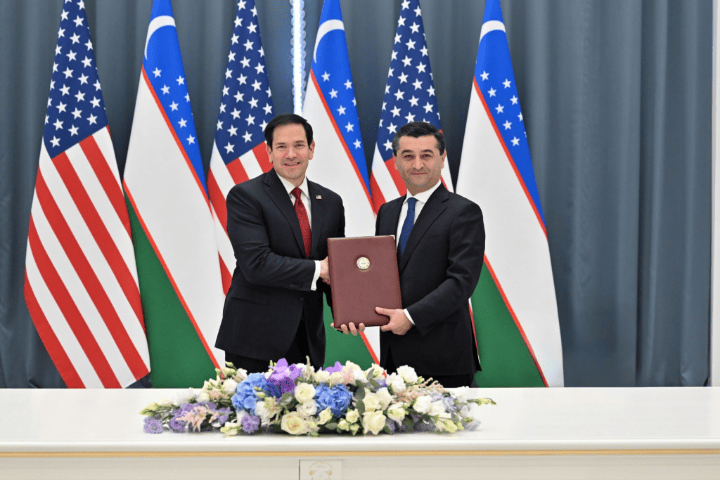
The historic city of Samarkand once connected merchants across continents. In October 2026, it again became a meeting point for international commerce as U.S. Secretary of State Marco Rubio visited Uzbekistan for talks with the five Central Asian countries. Beyond the diplomatic symbolism, the gathering highlighted a practical question: how can growing political engagement translate into investment, technology and lasting economic partnerships?
Rubio arrived in Samarkand on 18 October. The following day, the C5+1 ministerial meeting brought together the United States and Kazakhstan, Kyrgyzstan, Tajikistan, Turkmenistan and Uzbekistan to discuss trade, investment, transport links, energy and digital infrastructure. His visit also included talks with President Shavkat Mirziyoyev and a substantial business programme involving American and Central Asian companies. The emphasis was not only on identifying common priorities but on moving joint projects forward.
This cooperation has been developing for more than a decade. The C5+1 framework emerged in Samarkand in 2015, when then-U.S. Secretary of State John Kerry met his counterparts from the five Central Asian nations. It gained greater political visibility with the first leaders’ summit in New York in 2023 and a subsequent summit at the White House in November 2025. Alongside diplomatic dialogue, specialised formats for critical minerals and business cooperation have helped give the relationship a more tangible economic dimension.
For Uzbekistan, the United States represents more than an export market. It is also a source of financing, advanced technology and expertise in industrial modernisation. Following the high-level talks in 2025, the two countries established a Business and Investment Council to support major projects and help coordinate their implementation. Cooperation with the U.S. International Development Finance Corporation and the Export-Import Bank of the United States has opened additional possibilities for mobilising capital in energy, infrastructure, logistics, manufacturing, digital technology and pharmaceuticals.
Investment ties are also taking new forms. Uzbekistan’s National Investment Fund, managed by the U.S.-based Franklin Templeton, gained access to international equity markets through its London Stock Exchange listing in May 2026. Discussions with BlackRock have further demonstrated interest in privatisation, capital markets and strategic industries. These developments point to a wider ambition: to combine foreign capital with improvements in corporate governance and the performance of domestic enterprises.
Critical minerals have emerged as another important area of cooperation. Memoranda signed in 2024 and 2026 reflect a shared interest in developing secure supply chains for minerals and rare earth elements. Yet extraction alone would capture only part of the opportunity. For Uzbekistan, the more consequential objective is to develop processing capacity, transfer technology and create skilled jobs, enabling the country to participate in higher-value stages of production rather than merely supplying raw materials.
The trade figures suggest that the economic relationship is gaining momentum. According to Uzbekistan’s National Statistics Committee, bilateral trade grew from $215 million in 2017 to approximately $1 billion in 2025. In the first eight months of 2026, trade reached $810.4 million, an increase of 33.4 per cent compared with the same period a year earlier. Uzbek exports amounted to $304.5 million, while imports from the United States reached approximately $506 million. As of September 2026, 377 enterprises with American investment were operating in Uzbekistan.
These figures are encouraging, but the measure of success will not be the number of signed memoranda or announced projects. It will be whether financing is secured, facilities are built, technologies are transferred and production becomes competitive. Equally important will be the ability to connect national investment plans with regional transport corridors and more resilient supply chains linking Central Asia to European and global markets.
Samarkand’s October discussions therefore marked another step in a broader transition: from diplomatic contact to project-based economic cooperation. The opportunity for Uzbekistan is to use this momentum to diversify investment, expand industrial capability and strengthen its place in international trade. For both countries, the long-term value of the partnership will be determined by what happens after the meetings end.
Khurshed Asadov
Kategorier:Okategoriserade